When Satire Borrowed the Shape of a Fable
See how satire uses fable’s compact pattern of character, action and consequence to make an argument indirectly—and why that shape still invites fresh readings.
Satire gains a sly advantage from fable’s shape: a few recognisable characters act, face a consequence, and leave readers to complete the argument. That compact pattern lets a comic writer expose vanity or folly without turning a story into a lecture.
What makes a fable useful to satire?
A fable pares a conflict down to its working parts. A fox may flatter, a crow may boast, and a piece of cheese may change hands; the action makes a motive visible before anyone explains it. Satire can use the same economy to scrutinise human habits, institutions or public language.
The indirectness matters. A writer can assign a recognisable behaviour to an animal, a talking pot or a personified idea, giving readers a little distance from the target. The distance is not concealment so much as a change of angle: the audience sees the behaviour clearly because it is not surrounded by the target’s usual excuses.
Fable also makes consequences legible. A character’s choice leads to an outcome that can expose the gap between what they claim to value and what they actually do. The comic point emerges from that gap, much as a crooked ruler makes a straight line look all the more obvious.
How does the pattern work?
The basic movement is simple, though its effects can be subtle:
- Character: Give the central figure a trait readers can recognise, such as vanity, greed or obedience.
- Action: Let that trait shape a decision rather than merely describing it.
- Consequence: Make the result reveal something the character would prefer not to admit.
- Inference: Leave room for the reader to connect the fictional behaviour to a wider social habit.
That last movement distinguishes a satirical fable from a joke with a moral stapled on. The reader should be able to infer the criticism from the action, even if the story closes with a pointed line. If a narrator explains every implication, the fable’s compactness becomes a lecture in a small costume.
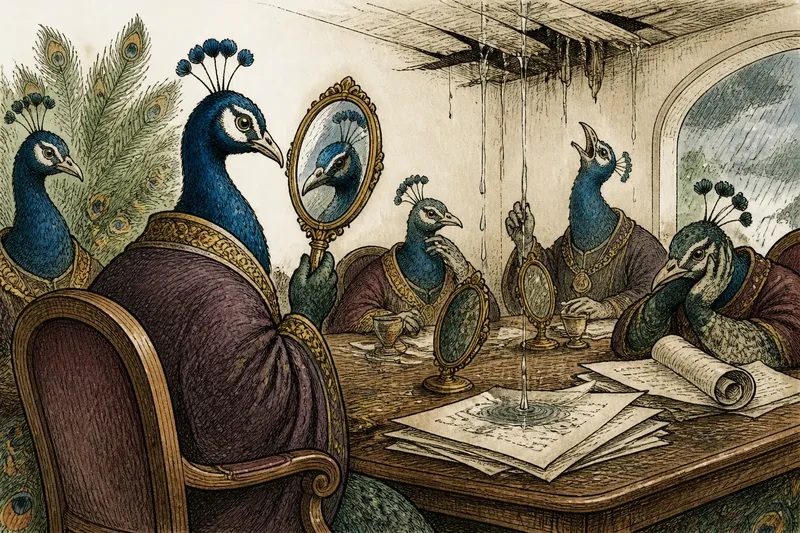
Say a writer invents a town council of peacocks that spends its meetings polishing a mirror while a leaking roof drips onto the agenda. The council’s vanity appears in its action; the rain supplies a visible consequence. Readers may recognise a broader criticism of officials who prize appearances over responsibilities, without the story naming a real council or claiming to describe one.
Why use animals or objects?
Animals and objects bring a built-in shorthand, but they are not neutral symbols with fixed meanings. A fox can suggest cunning in one story and resourcefulness in another; a locked box might stand for secrecy, preciousness or fear of change. The writer’s choices around speech, action and consequence determine which reading takes hold.
Non-human characters can also sharpen a contrast. A solemn goose announcing a policy to the pond may make grand public language sound absurd, while a chair refusing to move could turn stubbornness into a physical obstacle. Such figures invite readers to notice the habit before deciding how closely it resembles anything beyond the story.
There is a risk in relying on familiar animal roles. If every fox is merely sly and every donkey merely foolish, the characters can feel like labels rather than participants in a comic argument. A fresh reversal, or a consequence that complicates the expected moral, can make the form feel alert again.
What questions do readers ask?
Does a fable need an explicit moral?
No. A final maxim can focus the interpretation, but a consequence may carry the point more elegantly on its own. Leaving the moral unstated can invite readers to argue about whether the character’s punishment fits the behaviour.
How is a satirical fable different from a parable?
The forms overlap, and neither has an exclusive subject. Satirical fables tend to make folly, status or public conduct comic targets, while parables often foreground a spiritual or ethical lesson; tone and purpose matter more than the presence of talking animals.
Can a modern fable criticise an institution?
Yes: it can turn an institution’s habits into a small, readable system of characters and choices. The story’s invented setting should do the imaginative work, rather than serving as a thin disguise for an unsupported claim about a real organisation.
Why can an old fable acquire new meanings?
Later readers bring different expectations to its characters, authority and idea of fairness. A consequence once treated as satisfying may now look excessive, or a familiar animal may prompt a different association, opening the story to fresh argument.
Where can the form go wrong?
A fable’s clarity can turn blunt if every character stands for one idea and every event points to only one verdict. Real social habits rarely arrive so neatly labelled. A little friction—a sympathetic motive, an unintended result or a character who learns the wrong lesson—can make satire more perceptive without making it obscure.
The target also needs care. When a story mocks people with less power for being vulnerable, the fable’s distance may disguise cruelty as cleverness. Satire is sharper when its attention falls on the choices and systems that shape a problem, rather than treating hardship itself as the punchline.
Writers can check whether the form is carrying its own argument by asking what changes if the moral is removed. If character, action and consequence still make the contradiction visible, the fable is doing more than decorating a claim. If the point disappears, the story may need a more revealing choice or a less predictable consequence.
Why does the shape endure?
The fable remains useful because it is easy to retell and difficult to exhaust. A short sequence can travel through speech, print, performance or a new setting, while each audience decides what the old pattern resembles now. Retelling does not require preserving every detail; changing the character or consequence can expose a different pressure in the same basic conflict.
For readers looking at how satire borrows the shape of a fable, the lasting pleasure lies in the hand-off. The writer arranges a small world, the characters reveal themselves through what they do, and the audience supplies the wider comparison. A fable’s brevity is not an escape from complexity; it is an invitation to carry the argument beyond the final line.