The Door That Arrives Before the Punchline
Farce entrances and exits turn a familiar doorway into a pressure point, helping writers and performers build expectation through timing, sightlines and repetition.
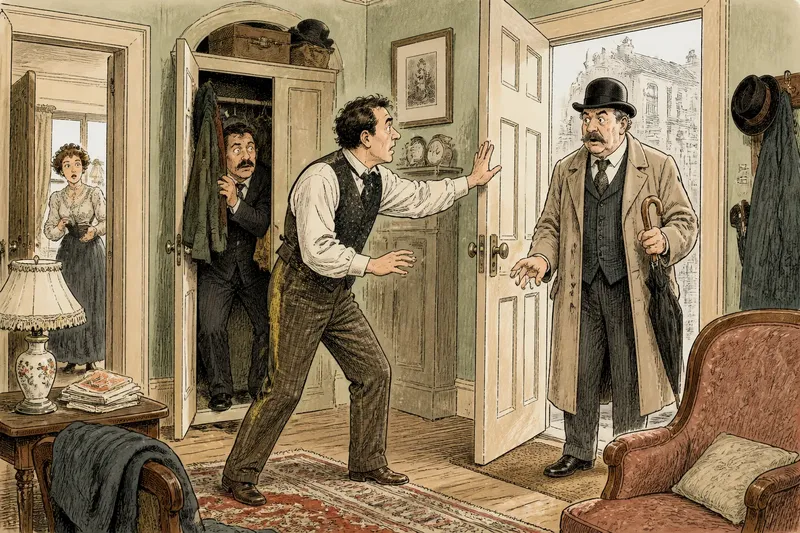
In farce, a door can make the audience laugh before anyone crosses the threshold. Farce entrances and exits teach us to expect a collision, a concealment or an inconvenient arrival; each return to the same opening loads the next one with extra pressure. The door is not merely scenery. It is a promise the actors keep making harder to ignore.
The threshold keeps score
A useful farce doorway has a clear job: it separates people who should not meet, or divides a character from the information they need. The audience can see the boundary even when the characters misunderstand it. That shared map lets a simple entrance carry several meanings at once.
Notice what changes each time the door opens. Perhaps a visitor arrives while the host is hiding a second guest; perhaps a character slips out just before another enters. The physical action may be similar, but the circumstances have shifted. The audience remembers the last crossing and begins to anticipate what this one might undo.
That memory is the mechanism. If every entrance were a fresh event, the sequence would feel like a queue. Repetition makes it feel like a pattern, and a pattern invites prediction. Farce can then reward the audience for spotting the danger while keeping the characters a step behind.
Expectation gains weight
The first crossing establishes the rule. A character hears a knock, hides something, and opens the door to the wrong person. Later crossings can tighten the same arrangement: there is less time to hide, fewer plausible places to go, or a visitor who knows more than the host expects. The pressure accumulates because the audience carries forward every unresolved complication.
Repetition should not mean duplication. A familiar entrance needs a changed consequence. The newcomer might interrupt a lie, block an escape route or mistake one character for another. Even a brief pause at the threshold can alter the audience’s prediction: is the visitor about to enter, or will someone inside stop them?
Think of a revolving kitchen door: the same panel swings round, but each arrival changes who is waiting on the other side. The analogy is modest, and so is the stage pattern. Its comic force comes from timing and arrangement, not from making the door itself seem magical.
Map the traffic
For a writer, the first practical task is to map who can enter from where and what each person believes. A rough floor plan can be enough. Mark the doors, the visible hiding places and the routes actors can take without crossing one another accidentally. Then track the knowledge each character carries at every point.
That map is not paperwork for its own sake. It catches a common weakness: a character arrives from a door that should be inaccessible, or misses a sound that ought to alert them. If the audience notices a logistical mistake before it notices the comic trap, the scene loses its clean rhythm.
- Give each entrance a clear cause, such as a knock, a call from offstage or a character returning for an item.
- Record what the entrant knows before crossing and what they can see once inside.
- Track who is hidden, who is visible and who believes the room is empty.
- Make each repeated crossing change a relationship, a piece of knowledge or an available escape.
- Check that an exit leaves the remaining characters with a fresh problem, not merely a quieter stage.
These checks are especially useful in a room with several doors. Too many routes can blur the audience’s mental map; too few can make the traffic feel contrived. A door earns its place when its location shapes the characters’ choices.
What should each crossing change?
How many entrances should a scene use?
Use enough crossings to establish a recognisable pattern, then vary what the audience expects from it. There is no useful fixed count: the scene needs each arrival to alter the pressure rather than simply add movement.
How can an exit be funny?
An exit can preserve a misunderstanding, strand someone with a dangerous secret or remove the one person who could explain the situation. It works best when the audience understands what the departure makes harder.
When should a repeated entrance change?
Change it when the original pattern becomes easy to predict without tension. A familiar visitor might arrive early, a hidden person might emerge, or the character who usually controls the doorway might find it blocked.
How can the audience follow several doors?
Give each route a consistent identity through position, sound or the direction an actor takes. Keep the important action visible, and avoid asking the audience to remember a complicated offstage journey during a fast exchange.
Timing lives at the edge
Actors do not need to rush every entrance. A hurried crossing can be funny, but so can the instant before it, when someone hears a familiar knock and tries to decide whether to hide, lie or pretend not to be there. That decision gives the audience time to recognise the danger.
Rehearsal can clarify the difference between a pause that builds expectation and one that drains it. The performer should know what sound or cue prompts the response, where the next person is, and what the character is trying to prevent. The movement then has a precise intention even when the character’s plan is foolish.
Sound helps establish the pattern. A knock, a latch or footsteps can alert the audience before the door moves, allowing anticipation to begin offstage. But if every arrival has the same cue, the sound may announce the structure too loudly. A change in cue can refresh the pattern without changing the room.
Build a pressure sequence
Say you are writing a scene in which a lodger has hidden a neighbour in a cupboard, and the landlord keeps returning to collect a misplaced umbrella. The first return establishes the concealment; the next arrives while the lodger is mid-explanation; a later one catches the neighbour trying to leave. The expected result is a growing sense of risk, because each visit narrows the characters’ options while the audience can see the trouble forming.
The sequence works because the landlord’s reason for entering remains ordinary. The comedy comes from the mismatch between a mundane errand and the increasingly elaborate effort to keep the secret. If every return introduces a more extraordinary visitor, the scene may lose the useful contrast between simple cause and crowded consequence.
For performance, make the changing stakes legible. The lodger might first hide the neighbour calmly, then begin to anticipate the landlord’s route, then react too quickly and draw attention. The same doorway now records a shift in confidence. The audience sees the pattern wearing down the character.
Let the pattern travel
When farce is revived in another room or for another audience, the entrances need not be copied mechanically. A narrow set, a thrust stage or a temporary venue may offer different sightlines and routes. The essential question is whether spectators can understand who is approaching, what the character fears and why this crossing matters more than the last.
That makes the doorway a flexible comic form rather than a fixed piece of furniture. A curtain, a stairwell or an imagined boundary can perform the same work if it creates a clear threshold and supports repeatable traffic. The staging may change; the audience’s growing expectation remains the engine.
When shaping farce entrances and exits, keep a simple record of what each crossing adds: knowledge, danger, delay or a new obstacle. If a return adds nothing, it may be decorative traffic. If it changes what the audience expects from the next arrival, the door has already begun delivering the punchline.