The Stage Version That Changes the Joke’s Owner
A stage adaptation can shift who seems to own a joke. Learn how voice, timing, space and audience attention reshape comic point of view.
A comic line on the page belongs, at first, to the voice that tells it. On stage, the same words may seem to belong to the actor who speaks them, the character who hears them, or the audience that catches the implication first. That change of ownership is one of adaptation’s richest opportunities: performance can make a joke expose a new target without changing a syllable.
For a writer adapting comic prose, the task is not simply to preserve the punchline. It is to decide who appears to know what, who has the power to make the room laugh, and who is left carrying the joke. These choices emerge through staging as much as dialogue. The following five shifts offer a way to hear how the point of view moves.
1. The narrator becomes a body
On the page, a narrator can deliver a cutting observation from a safe distance. Stage performance gives that voice a body, a face and a place in the room. Suddenly the audience can ask: is this person a detached observer, a participant pretending not to care, or the very person being mocked?
A narrator’s dry description of a pompous official may sound impartial in prose. Put those words in the mouth of a clerk standing beside the official’s desk, and the joke acquires a social position. The clerk may be risking something by speaking, or may be using the audience as a private ally. Either reading changes the comic pressure.
Adaptors can make that shift legible through simple choices. Let the speaker look at the object of the joke, address the audience directly, or keep their eyes fixed on a document. A direct look can make complicity feel deliberate; a refusal to look may suggest fear or embarrassment. The words remain, but their apparent owner changes.
There is a useful distinction between a narrator who reports a joke and a character who performs one. Reporting can make the line sound like a verdict. Performing makes it an action with consequences. On stage, the audience sees the speaker take that action, and the character’s standing in the scene becomes part of the laugh.
2. The listener takes the punchline
In prose, a punchline often lands where the writer places it. The reader reaches the final words, registers the turn and moves on. In performance, the listener’s response can become the scene’s strongest comic event. A raised eyebrow, a delayed answer or a carefully maintained silence may claim the laugh before the next line arrives.
That does not mean the listener needs a new joke. The actor can receive the existing line as if it were a gift, an insult or a piece of information they already suspected. Each response points the audience towards a different target. If the listener seems delighted, the speaker may look foolish. If the listener looks stricken, the line may expose the cruelty of the person who said it.
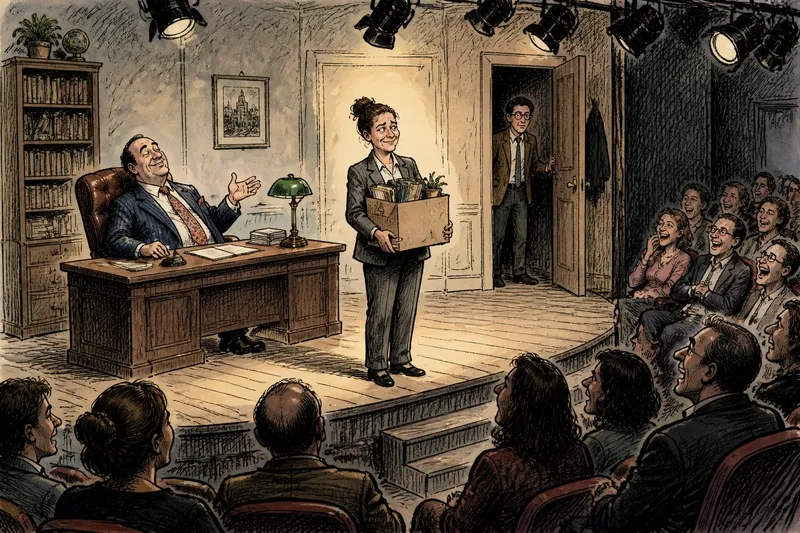
Imagine an invented scene in which a manager praises an employee’s “remarkable flexibility” after moving the employee’s desk yet again. On the page, the phrase might read as the manager’s wry aside. On stage, the employee could look down at the box of belongings in their arms, then smile too brightly. The audience may laugh at the manager’s euphemism, the employee’s forced politeness, or the discomfort between them; the actor’s response steers which reading takes hold.
For an adaptor, the practical question is not merely how long to pause. It is whose face the audience sees during the pause. Holding on the speaker can make the laugh feel like self-satisfaction; holding on the listener can make it feel like recognition or resistance. A pause is a small frame around a person’s reaction.
3. Shared space redistributes power
A written scene can describe who is present without making their relationships physically visible. A stage has to arrange bodies. Distance, height, entrances and exits can quietly decide who controls a comic exchange, sometimes more decisively than the dialogue.
Consider who gets the centre of the space and who must lean in to be heard. A character seated behind a broad desk may appear to own a joke before speaking. Someone standing in the doorway can seem to interrupt the room’s authority simply by refusing to come further in. Such choices give the audience a visual argument that may support, complicate or contradict the line.
Blocking can also transfer a joke between characters. If the person being teased has to cross the room to fetch an object while everyone else watches, the laugh may attach to the group’s behaviour rather than to the individual’s supposed flaw. If that person remains still and makes the others wait, the same situation can turn into a small act of command.
These spatial meanings need not be grand or symbolic. A chair turned away from the table, a coat someone refuses to remove, or a character who keeps the door open can give a comic moment its social shape. The stage makes the audience watch who has room to move and who has to accommodate whom.
4. The audience joins the scene
A reader encounters a comic passage privately, at a pace they can control. A theatre audience hears it together. Laughter becomes audible, uneven and contagious; the performers can hear it too. That shared response changes the scene because the audience is no longer only interpreting the joke. Its reaction has become part of the event.
A character who turns towards the house after a line can appear to recruit the audience as an accomplice. The same line delivered without eye contact may feel like an overheard remark. Neither choice is inherently funnier or fairer. Each assigns the audience a different role, and that role affects who seems to own the joke.
There is also a difference between inviting a laugh and demanding one. A performer can leave room for the audience to decide how to respond, or can underline the intended target with a gesture or tone. Too much emphasis may narrow a scene that once allowed several readings. A lighter cue can preserve ambiguity while still making the stage version clear.
Adaptors should consider what happens when laughter interrupts the next line. If the following words depend on a particular character’s authority, losing them under the laugh may quietly transfer power to the person who provoked it. If those words are essential, the staging may need a beat that lets the response pass before the scene continues. Timing is not just comic polish; it affects who gets heard.
5. Repetition changes the target
Comic prose can repeat a phrase on the page and let the reader notice the pattern at their own speed. On stage, repetition unfolds in time and arrives through a particular performer. The first delivery teaches the audience what to expect; the next can deepen the joke, expose the speaker’s habit or reveal that the listener has learned how to use it.
Suppose a character repeatedly calls every inconvenience “a minor adjustment”. At first, the phrase may make that character seem breezy. Later, another character might echo it while shifting a heavy pile of boxes across the room. The words have not changed, but their owner has. The echo can turn the original speaker’s evasive language into evidence against them.
Repetition also gives an actor choices about variation. A phrase can return with the same clipped rhythm, suggesting a rehearsed defence, or with a changed emphasis that makes its hidden meaning newly audible. The point is not to decorate every return. It is to decide whether the speaker still controls the phrase or has begun to be controlled by it.
Because the stage makes a repeated line visible as well as audible, the actor’s relationship to it can develop. A hand gesture that once seemed casual may become an awkward routine; a smile may gradually stop reaching the eyes. The audience watches a comic mechanism acquire a cost, and the joke’s target can shift from a foolish phrase to the person who depends on it.
Questions about ownership?
Does every stage adaptation need new dialogue?
No. A change in gaze, position, response or timing can alter the apparent target while preserving the words. New dialogue is useful when the audience cannot follow the relationship through performance alone, not simply because the material has moved to a stage.
How can a performer make a listener’s reaction comic?
Give the reaction a clear point of view: the listener may recognise the speaker’s bluff, conceal hurt or decide to play along. A precise, readable response usually says more than a string of exaggerated expressions.
When does direct address change the joke?
Direct address turns the audience into a witness or accomplice, even if only for a moment. Use it when that relationship matters to the scene; a look towards the house can otherwise make a private exchange feel like commentary.
Can staging preserve more than one reading?
Yes. A performance can make a line’s surface meaning clear while leaving its moral or social meaning unsettled. Give the actors room to respond naturally, and avoid adding cues that tell the audience exactly whom it must laugh at.
Keep the transfer visible
When adapting a comic scene, mark who speaks, who listens, who moves and who receives the audience’s attention at each turn. Then ask whether those choices make the same person seem to control the joke as on the page. If the answer changes, decide whether that shift is the point or an accidental by-product of staging.
The stage version that changes the joke’s owner can make familiar words feel newly unsettled. A line may begin as a narrator’s observation, pass through an actor’s expression and end as the audience’s shared recognition. Treat that transfer as part of the writing, not a flourish added after it. Like a parcel handed across a table, the joke changes meaning with every person who takes hold of it.