A Rewatch for the Joke That Changes Meaning
A rewatch for the joke that changes meaning helps you hear how a recurring gag shifts as a comic character’s history becomes familiar.
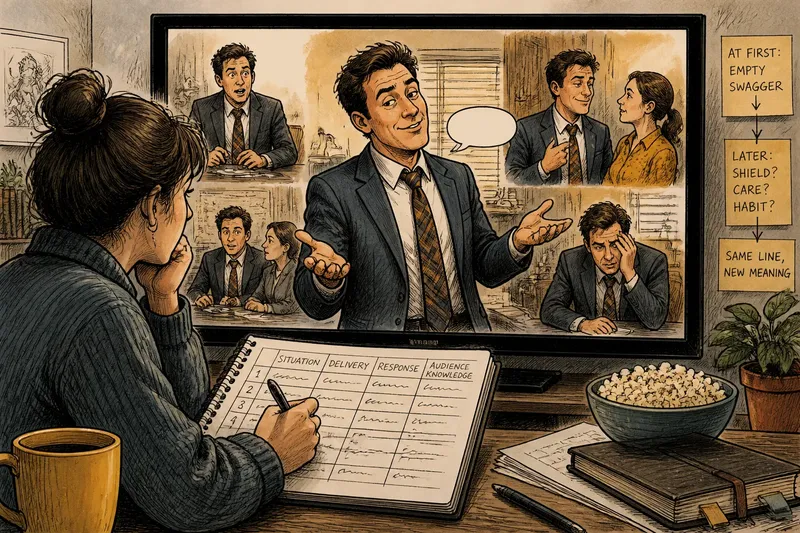
A rewatch for the joke that changes meaning begins with one recurring gag, not a whole series. Choose a line, gesture or small ritual that returns often, then watch how your knowledge of the character changes what it seems to say. The words may stay put; the audience’s understanding does not.
This is a close-reading exercise, but it should feel more like keeping a few notes beside the screen than taking an exam. You are tracking the gap between what the character appears to mean and what a returning viewer has learnt to hear.
Choose one recurring joke
Pick a comic pattern with enough appearances to compare. It might be a character’s boast that routinely outruns their ability, an excuse that becomes more elaborate each time, or a familiar phrase used in new circumstances. Avoid a gag whose meaning depends on a plot reveal you cannot comfortably revisit; the point is to follow a changing interpretation, not solve a mystery.
Make the choice narrow. “The character is always foolish” is too broad to watch closely. “They announce that they have everything under control whenever a plan starts to unravel” gives you something audible and specific to find.
Write down the wording or action as accurately as you can, along with the scene where it occurs. If you are watching a screen comedy, episode notes or captions can help you locate a moment later. For a live recording, note the surrounding exchange instead; a cue such as “after the visitor asks about the letter” may be enough to find the passage again.
Record your first reading
Before replaying the early appearance, write what the joke seems to mean on a first encounter. Keep it plain: perhaps the character sounds confident, defensive, vain or genuinely surprised. Then note what you think the scene asks you to notice. Does another character react? Does the performer stress a word, hurry through the line or leave a small pause?
Do not try to make the first reading clever. It is a baseline, not a verdict. A joke can be amusing because a character is blind to their own habits; later knowledge may make that blindness look affectionate, lonely or calculated instead.
Say you choose an invented sitcom in which a manager calls every improvised decision “the plan”. In an early scene, the phrase might sound like empty swagger. You would record that first impression, then leave open the possibility that later scenes change its flavour.
Replay in sequence
Watch each appearance in order, including the exchanges immediately before and after the recurring gag. A line can acquire new meaning through a later event, but it can also be reshaped by a colleague’s weary look, a sudden change of subject or the character’s effort to keep a straight face. The joke is not always contained in its repeated words.
For every return, jot a few observations:
- Situation: What has just happened, and what does the character stand to lose or gain?
- Delivery: Is the line brisk, hesitant, rehearsed or unusually sincere?
- Response: Who laughs, objects, ignores it or quietly helps?
- Audience knowledge: What do you now know that you did not know during the first appearance?
Keep these notes distinct. “The line sounds sad” is an interpretation; “the character says it alone, after a friend has left” records what supports that interpretation. Separating observation from judgement makes it easier to notice when the programme itself supports several readings.
Track the audience’s knowledge
Now ask what a returning viewer knows at each appearance. Perhaps the character has made the same promise before, revealed a private fear, or shown that their bluster is aimed at a particular person. The joke may begin as a simple mismatch between claim and reality, then become a familiar signal: we recognise the pattern before the character does.
That recognition changes the audience’s position. At first, you may laugh at the character. Later, you may laugh with them, anticipate their mistake, or feel an uneasy mix of affection and impatience. These are not mutually exclusive. Comic writing often keeps the original contradiction intact while letting accumulated knowledge complicate the target.
Think of a recurring joke as a kitchen timer on a crowded counter. The object stays the same, but the person listening knows more about what is cooking each time it rings. In comedy, that added context can make a familiar line sound less like a boast and more like a shield—or make a seeming confession turn out to be another performance.
Compare the returns
Place the appearances side by side in your notes. Look for a change in the joke’s function rather than only a change in wording. Does it now expose a habit, protect a relationship, cover embarrassment or remind the audience of a promise the character has forgotten?
Return to the invented manager. In the imagined first scene, “the plan” is a puffed-up answer to a routine setback. Later, the manager uses the same phrase while trying to reassure a nervous colleague. If the delivery softens and the colleague accepts the reassurance, a viewer who remembers the earlier bluff might now hear both the old vanity and a sincere attempt to help. That is a changed reading, not necessarily a changed joke.
Also notice what remains stable. The character may still overstate their control, and the audience may still know better. The shift can lie in how much sympathy the surrounding scenes invite, or in whether the repeated phrase feels like a flaw the character is trapped in or a tool they have learnt to use.
When does a recurring joke change?
Does the wording have to change?
No. A repeated line can acquire fresh meaning through new circumstances, delivery or audience knowledge. Record what is different around it before deciding that the joke itself has changed.
What if the joke lands the same way?
That is useful too: the repetition may be there for rhythm, recognition or a reliable character trait. Note the consistency rather than forcing a transformation the scenes do not support.
Should I watch with captions?
Captions can help with exact wording, especially when a phrase returns in slightly altered form. For timing, glances and reactions, watch the scene again without pausing so the performance retains its flow.
Can I include the audience’s changing feelings?
Yes, but separate your response from what the scene makes observable. You might feel more protective of a character later; note which events or performance choices prompted that feeling.
Write a careful reading
Finish with a short account that links the first appearance to the later one. Name the repeated feature, describe the new knowledge the audience has acquired, and explain how that knowledge alters—or leaves unchanged—the joke’s target. Use one specific detail from the performance, such as a withheld response or a shift in emphasis, rather than treating the plot as the only source of meaning.
Leave room for another viewer to disagree. A recurring gag may invite sympathy for the character while still exposing their self-deception. If your notes support two plausible readings, say so and point to the detail that keeps each alive.
This rewatch for the joke that changes meaning is most useful when its final claim stays modest: the joke sounds different because the audience now knows more about the person repeating it. You need not settle what the character “really” means. The sharper observation may be that the joke lets both the old laugh and the newer understanding sit in the same room.